
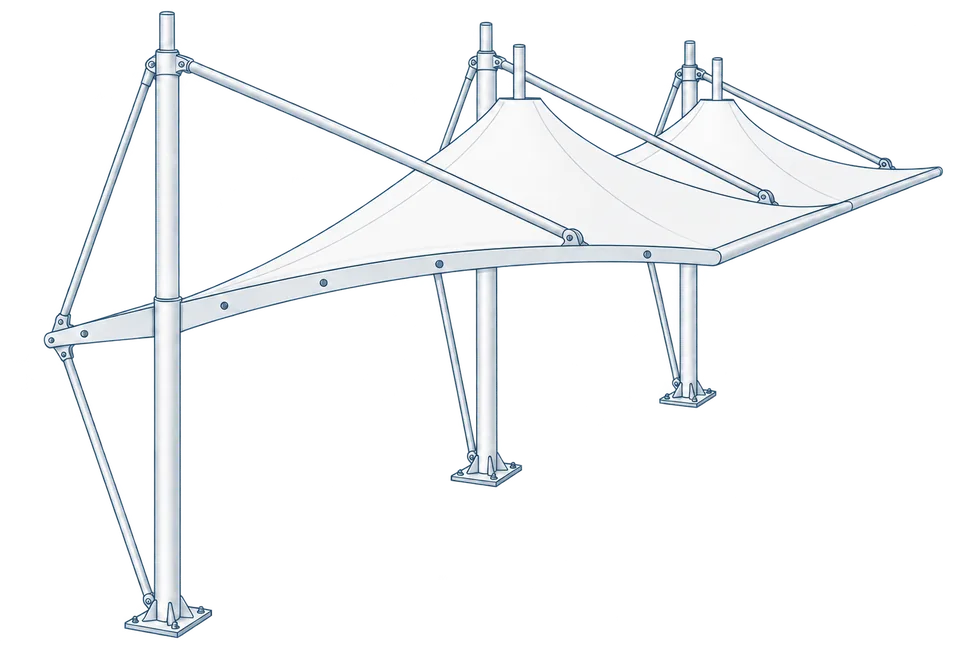
 Membrane carportsClassic membrane shelters→
 Solar carportsParking meets green energy→
 Landscape canopiesParks and leisure spaces→
 Grandstand canopiesSports venue shelters→
 Inflatable play cloudsFamily play areas→
 Wastewater coversEnvironmental infrastructure→
 Fuel station canopiesStation shelters→
 Entrance canopiesWalkways and entrances→
RFQ for a Tensile Membrane Structure with Incomplete Drawings: How to Tell a Budget Estimate from a Formal Quotation?
When drawings and site information are incomplete, a quotation for a tensile membrane structure project can only reach the level of a budget estimate, not a formal quotation. The reason is straightforward: the cost of a membrane canopy — for example, a carport for vehicle parking or a bicycle shelter — varies widely with span, membrane type, steel tonnage and foundation conditions. Without drawings there is no basis for calculation, so a fabricator can only quote from experience-based ranges. When information is missing, it is more reliable to grade the quotation by its level, then supply data step by step, than to compare a single vague total price across suppliers.
Three levels of quotation at the RFQ stage
At the RFQ (request for quotation) stage, quotations generally fall into three tiers depending on how complete the information is:
- Budget estimate: only the intended use and approximate dimensions are known. The fabricator gives a cost range based on similar projects and states clearly that it is not based on calculation — useful for project approval or internal budgeting only.
- Concept-stage quotation: preliminary drawings or measured site data exist; span, membrane category and steel structure form are defined. The price range narrows and can be used for comparing options.
- Formal quotation: design conditions are complete, itemized quantities and configurations are written into the quotation, and the document can serve directly as a contract attachment.
Each layer of information supplied moves the quotation down one tier. Pressing a fabricator for a fixed lump-sum price without drawings shifts the risk of later changes and disputes onto the buyer.
What separates a budget estimate from a formal quotation?
The difference is not precision of the number but whether the underlying assumptions hold:
| Item | Budget estimate | Formal quotation |
|---|---|---|
| Basis | Use, approximate size, comparison with similar projects | Concept drawings, measured data, confirmed configuration |
| Span and structure form | Assumed values | Values confirmed after design review |
| Membrane material | A category range (e.g. standard PVC or upgraded PVDF) | Specific grade and membrane fabricator warranty |
| Supply scope | Described verbally, boundaries unclear | Itemized in writing, written into the contract |
| Use | Project approval, internal budgeting | Contract signing and settlement |
A budget estimate rests on assumptions; a formal quotation rests on confirmed conditions. If an assumption changes, the numbers must be recalculated.
Which missing documents distort the price most?
For an RFQ on a tensile membrane structure, if any of the following is missing, the quotation can drift from reality:
- Site dimensions and headroom: span, obstructions, and where columns can be placed — these directly determine steel tonnage.
- Foundation conditions: whether the ground is fill or hardened paving, and whether a geotechnical report exists. Different foundation solutions carry very different costs.
- Membrane selection: standard PVC or upgraded PVDF, and whether a flame-retardant (B1-class) grade is required. Warranty terms for membrane and steel follow this choice.
- Local wind and snow loads: in large-span or high-load regions, member sections must increase. If this is not checked at the estimate stage, the formal quotation can rise noticeably.
- Site conditions: level ground, crane access, and schedule requirements all affect what the installation portion of the supply scope includes.
How to fill the information gaps
There are two routes:
- If drawings exist, complete the missing items first: obtain the site dimension plan, foundation data and load conditions from your designer or owner, align them item by item, then request a formal quotation.
- If no drawings exist, arrange site measurement: for large domestic sites, Qingsong Membrane Structures can, after communication and confirmation, carry out on-site drone surveying to quickly capture actual dimensions and boundaries; small sites generally only need manual measurement. Overseas buyers should instead commission local site measurement and share the resulting dimensioned drawings and photographs.
Once measured data is in hand, design work can proceed one to one. Only when the scheme is settled can the quotation move from a budget estimate to a formal quotation.
When can a budget estimate become a formal quotation?
Meet these four conditions:
- Site dimensions confirmed by survey or drawings, with span and other key parameters fixed;
- Membrane category and flame-retardant configuration confirmed in writing;
- Foundation and installation conditions verified, with the supply scope itemized;
- Wind and snow loads calculated for the actual project location.
With all four met, the quotation can serve as a contract attachment, and warranties for membrane and steel fabrication should be written into the contract in full — no verbal promises. This is the single most important thing to lock down at the RFQ stage.
Who should review the formal quotation?
It depends on how the project is organized. If you have a design firm, have them check the supply scope and quantities against the scheme drawings. For owner-managed or facility-management projects, have internal staff familiar with construction review the itemized list for omissions, or appoint a cost consultant. For schools and institutions following formal procurement procedures, confirm the quotation format meets the attachment requirements for approval. The purpose of review is not to squeeze the number but to verify the boundaries of the supply scope: does it include foundations? Lifting equipment? Site coordination? Every item must be written into the document.
Qingsong Membrane Structures manufactures at its factory in Henan, China, with components prefabricated in the factory and delivered by logistics. Design, fabrication, surface treatment and installation are handled as one integrated service for domestic projects, with a unified national warranty. Factory visits and completed project references can be arranged on request. Because costs vary widely with span, membrane material and configuration, you are welcome to contact the factory for a scheme proposal. For cross-border procurement, note that installation is provided through the company's domestic service network; overseas projects should define design coordination, custom fabrication and supply scope, packing lists and handover to local installers with the buyer and their project engineer.
Frequently asked questions
Only a hand-sketch of the site exists — can I get a quotation?
Yes, at budget-estimate level, for reference. A formal quotation requires confirmed dimensions, membrane configuration and foundation conditions.
How far will the final price differ from the estimate?
It depends on how far the assumptions deviate from the actual scheme. Whichever factor — span, membrane or foundation — changes most will be the main source of the difference, which is why a budget estimate must state its assumptions.
How detailed should the supply scope be?
Detailed to item level: design, steel fabrication, membrane fabric, surface treatment, transport, installation and warranty — what each includes, written clause by clause into the contract, with nothing left verbal.
To start the conversation, prepare your project's intended use, dimensions or available drawings, and the range of services you wish to commission. Share your project location, intended use, dimensions and available drawings via our contact page, and tell us which design coordination, custom fabrication and supply services you need so we can review the scope.