 Membrane carportsClassic membrane shelters→
 Solar carportsParking meets green energy→
 Landscape canopiesParks and leisure spaces→
 Grandstand canopiesSports venue shelters→
 Inflatable play cloudsFamily play areas→
 Wastewater coversEnvironmental infrastructure→
 Fuel station canopiesStation shelters→
 Entrance canopiesWalkways and entrances→
RFQ for a Tensile Membrane Cover Over a Wastewater Tank: Who Confirms the Tank Data, Access Openings and Equipment Interfaces?
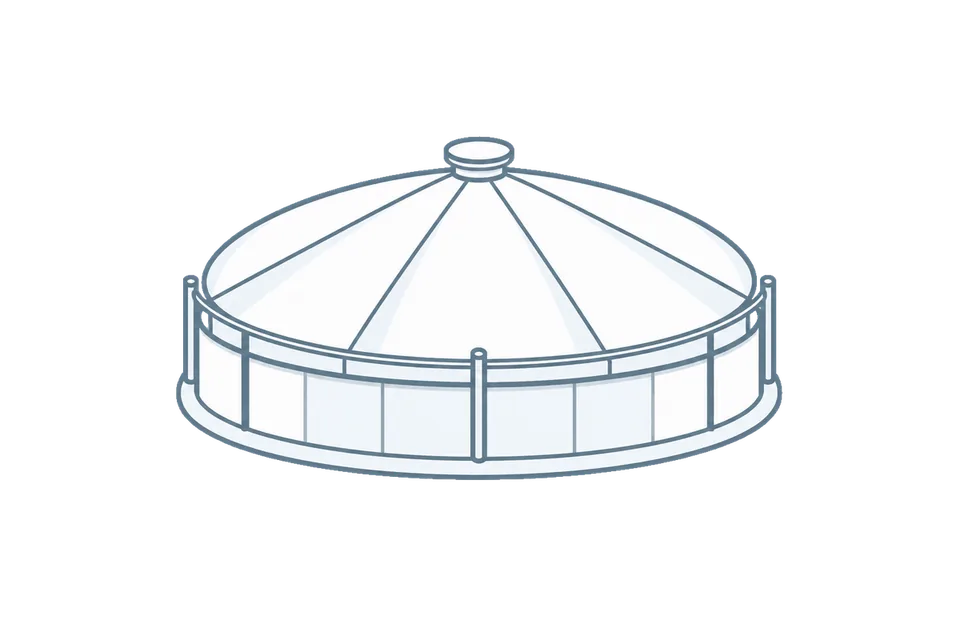
In an RFQ (request for quotation — your formal inquiry asking suppliers to price a defined scope) for a tensile membrane structure covering a wastewater tank, the biggest risks are usually not the membrane itself but the interfaces between three parties: who supplies the tank data, who lists and confirms the access openings and equipment penetrations, and where the supply scope of the membrane cover ends and the odor-control equipment scope begins. If these three points are not clarified before quotations are prepared, you risk duplicate pricing, missing items and disputed responsibility later. Listing the required documents and interface responsibilities up front is what makes quotations comparable.
What tank and process data should be included in the RFQ?
Tank data is the basis of any quotation and should mainly be provided by the owner or the environmental engineering contractor, including:
- Tank plan dimensions, wall height and structural form (concrete or steel).
- Existing items on the tank roof: walkways, railings or pipe supports that must be retained or avoided.
- The medium inside the tank and operating conditions: temperature range and whether corrosive gases are released.
- Local wind and snow conditions, used for load calculations on the frame and membrane.
- Site conditions around the tank: lifting space, transport access, and whether scaffolding can be erected.
If the owner has no existing drawings, tank dimensions can be confirmed by site surveying. For the projects described by the Chinese source, drone surveying is used, which avoids work at height on large tank groups and reduces disruption to tanks in operation. Process/medium data must be provided truthfully by the owner: it directly affects the recommended membrane and frame selection, and the designer will verify against this data rather than rely on assumptions.
How should access openings and equipment interfaces be itemized and confirmed?
Access openings and equipment penetrations are the most commonly missed items in a suspended (reverse-mounted) membrane cover scheme. Recommend itemizing them during design, and for each opening record three things: location, size, and who is responsible for forming the opening and sealing it.
Typical interface items include:
- Access openings: location and opening method for personnel entry, and whether a door or hinged cover is required.
- Observation windows: for inspection; the operator specifies position and quantity.
- Exhaust duct outlets: connection position and diameter for the collection ductwork.
- Penetrations or wall passages for pumps, agitators, level gauges and similar equipment.
- Provisions for later entries such as dosing lines and cable trays.
The environmental engineering contractor should lead the list based on process requirements; the membrane structure designer then confirms, on the drawings, whether each opening is achievable in the membrane surface and how it will be trimmed and sealed. Only after both parties have located every opening on the design drawings should fabrication begin. On the model described in the source, design, fabrication, surface treatment and installation are handled under one process, so confirmed opening positions go directly into fabrication and rework is avoided.
How is the supply scope divided between the membrane cover and the odor-control equipment?
The boundary is simple: use the exhaust duct outlet as the dividing line. Inside the outlet (membrane, frame, access openings, sealing details) belongs to the membrane cover supply scope; outside the outlet (collection ductwork, fans, treatment equipment) belongs to the odor-control equipment scope.
When issuing the RFQ, state clearly in the schedule:
- The membrane cover supplier is responsible for: membrane surface, steel frame, foundation embedments or anchorage, duct outlet provisions and sealing collars.
- The odor-control equipment supplier is responsible for: ductwork, fans, treatment units and their supports.
- Both parties coordinate the duct connection on site, with responsibility defined at the interface.
With the scope listed this way, the two quotations contain no overlapping items, and the owner does not pay twice for the same thing.
What if hot work is not allowed on site?
Flammable gases can accumulate above wastewater tanks, and many sites do not permit welding. In such cases, agree in advance on a bolted construction method: members are prefabricated and surface-treated in the factory, delivered as finished components, and connected on site mainly by bolting, with no on-site welding. Because no fabrication happens on site, the installation schedule is also easier to control. This must be raised at the RFQ stage so the frame connections are designed as bolted joints.
Can projects outside the supplier's home region be accepted?
The Chinese source states that the supplier can accept projects in different regions: members are prefabricated at its Henan factory and shipped directly, with installation handled through a partner installation service network and a unified nationwide warranty. Installation quality is controlled by the supplier's own installation team, since membrane tension and sealing depend heavily on site execution.
For overseas projects, what is actually available — design coordination, custom fabrication, export packing and what part of the supply scope — should be agreed with you and your project engineer before the quotation. On-site installation arrangements outside the supplier's home market are a matter to confirm explicitly; this article does not promise overseas field installation service.
Qingsong Membrane Structures uses its Henan factory as the manufacturing base and welcomes factory visits and visits to completed projects; component warranties for membrane and steel are written into the contract rather than given verbally.
FAQ
Is process/medium data mandatory before designing a suspended membrane cover? Yes. The medium type and tank temperature affect membrane and frame selection. Without it, the designer can only offer a generic scheme, and the selection risk falls on the owner.
Can access openings be cut later? Not recommended. Openings in a membrane surface require edge-trimming and sealing design; providing for them at the design stage is far simpler and cheaper than retrofitting.
Can one supplier provide both the odor-control equipment and the membrane cover? This can be negotiated, but the supply scope should still be divided at the duct outlet and written into the contract — even with a single supplier, this enables separate acceptance and separate warranty by scope.
To discuss your project, please prepare the intended use, dimensions or drawings, and the range of design coordination, fabrication and supply services you want to commission. Share these with us through our contact page and we will prepare a proposal based on the information provided.
To start, share your project location, intended use, tank dimensions and available drawings via our contact page, and tell us which design coordination, custom fabrication and supply scope services you need so we can review the requirements.