
 Membrane carportsClassic membrane shelters→
 Solar carportsParking meets green energy→
 Landscape canopiesParks and leisure spaces→
 Grandstand canopiesSports venue shelters→
 Inflatable play cloudsFamily play areas→
 Wastewater coversEnvironmental infrastructure→
 Fuel station canopiesStation shelters→
 Entrance canopiesWalkways and entrances→
How Is the Shape of an ETFE Cushion Determined? Why Rise Height and Corner Angles Matter
An ETFE cushion is not made by simply sketching a plan outline. For the same plan shape, how high the cushion bulges and whether the boundary corners are sharp or obtuse directly affect structural performance and appearance. The rise height controls the curvature of the inflated surface, while the corner angles determine whether the membrane can tension evenly at each corner. This article is written for owners and purchasing teams working on ETFE cushion projects. It explains the basic principles of shape design so you can read the logic behind design drawings during early-stage coordination.
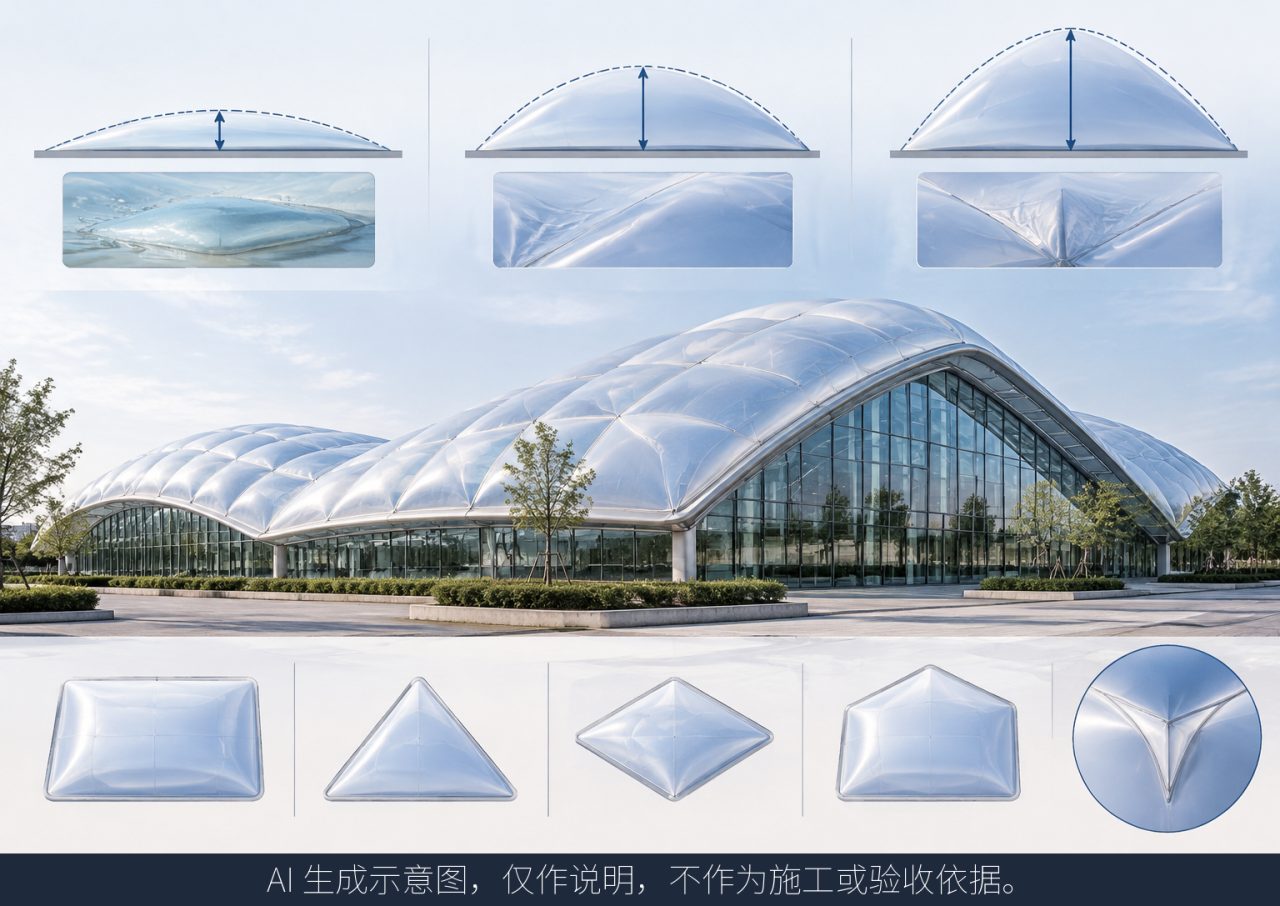
Rise-to-Span Ratio Too Flat: Lower Capacity and Ponding Risk
The rise-to-span ratio is the rise height divided by the plan span of the cushion. When this ratio is too small, the cushion surface is very flat—close to a plane—and the membrane relies mainly on its own tension to carry loads, which significantly reduces load capacity. Snow load and wind uplift are transferred primarily by converting loads into membrane tension through curvature; the flatter the surface, the less usable curvature there is.
A flat shape also creates a common drainage problem. When the cushion surface is nearly horizontal, rainwater and melting snow flow slowly and can pool in low areas. Ponding adds load, which presses the membrane down further, creating a vicious cycle. So although a flat profile looks clean and simple, it should be used with caution in regions with heavy snow or rainfall.
Rise-to-Span Ratio Too Large: Problems from Over-Bulging
Conversely, a ratio that is too large—an over-bulging cushion—is also not ideal. For cushions with corners (rectangular or diamond shapes, for example), heavy bulging forces the membrane near the corners to tension in several directions at once. Local stress concentrates, and wrinkles tend to form at the corners. Wrinkling affects appearance and can also weaken sealing and durability in the corner region.
An over-bulging cushion can also look visually intrusive and needs to be weighed against the overall architecture. Shape design is essentially a balance between flat and bulged: flat enough to drain and carry load, bulged enough to avoid wrinkling and stay visually coordinated.
Why Very Sharp Corner Angles Wrinkle
If the boundary angle in the plan outline is too small—that is, the corner is too sharp—the corner is again prone to wrinkling. The reason is that membrane is a flexible material, and once inflated the surface must tension evenly. When the angle is small, the boundary directions on either side of the corner run nearly parallel, so the membrane near the apex cannot satisfy the tension requirements in both directions simultaneously. The local stress distribution becomes disordered and wrinkles appear.
For this reason, designers keep corner angles within a reasonable range during the design stage, and where necessary relieve stress concentration by cutting off the corner or introducing an arc transition. The specific minimum angle is determined by the project design; it varies with different outlines, spans and load conditions.
Common Cushion Shapes
Shapes frequently used in practice include:
- Rectangular and strip-shaped: the most common, well suited to grid layouts on roofs and facades, with corner angles close to right angles that let the membrane tension evenly;
- Triangular: often used where form or building geometry requires it; corner angles vary widely and sharp corners need special treatment;
- Diamond-shaped: offers visual variety, but the acute corners carry a higher wrinkling risk;
- Polygonal: greater design freedom, but where adjacent polygons are not coplanar, level differences along shared boundaries should not be too large, or surface forming and edge connections become difficult.
Shape selection should combine the building grid, drainage direction, load conditions and fabrication feasibility—it should not be based on renderings alone.
Who Determines the Actual Values
This article covers principles only and does not give specific rise-to-span ratios or angle values. These parameters must be determined through structural analysis. The thickness and number of layers of the ETFE film are likewise set by structural analysis, and multi-layer, multi-chamber cushions require analysis of how the chambers interact with one another. Every project has different spans, loads and grid layouts, so values differ from case to case; the project's design calculations and material documentation govern.
Qingsong Membrane Structures can develop a customized cushion scheme for your project's conditions. Shape, grid layout and film configuration are worked out at the design stage together with the load case. If you would like to discuss your ETFE cushion project, please prepare the intended use, dimensions or available drawings, and the scope you wish to commission—design coordination, custom fabrication, supply scope, or installation interface support—so we can review the scope and respond with a targeted proposal.
To start, share your project location, intended use, dimensions and drawings, and tell us which services you need so the scope can be reviewed.