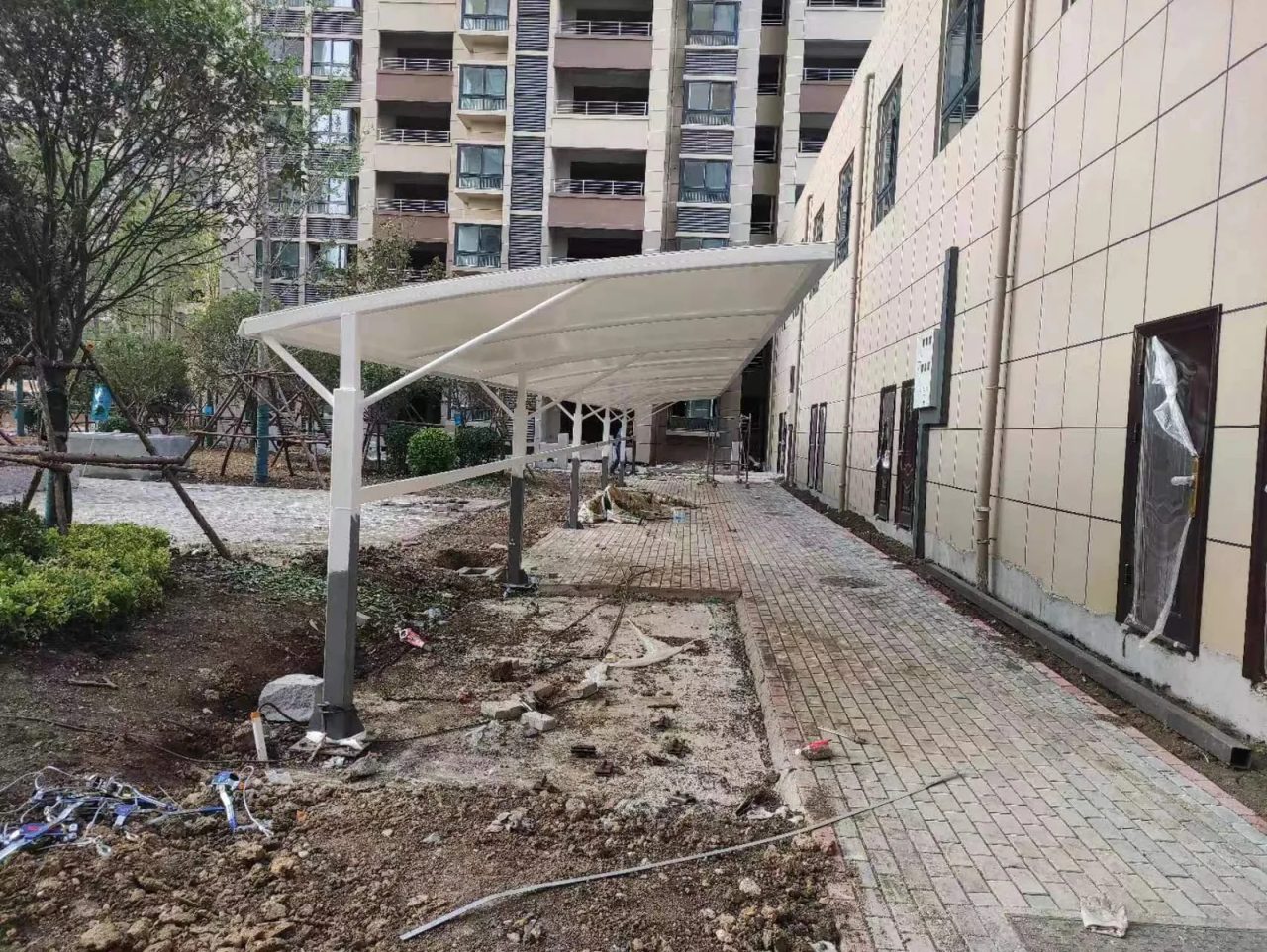
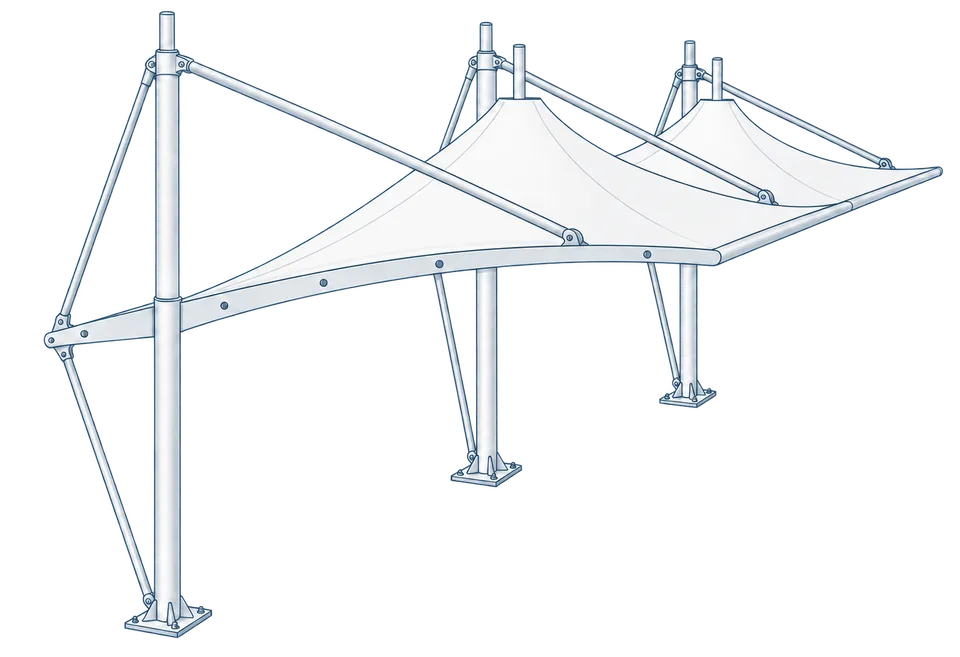
 Membrane carportsClassic membrane shelters→
 Solar carportsParking meets green energy→
 Landscape canopiesParks and leisure spaces→
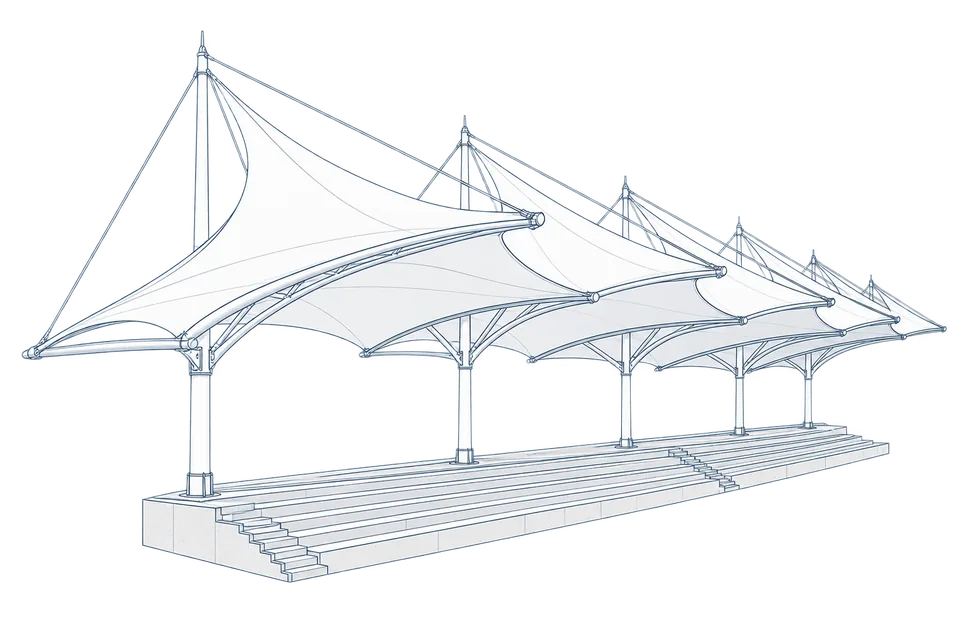 Grandstand canopiesSports venue shelters→
 Inflatable play cloudsFamily play areas→
 Wastewater coversEnvironmental infrastructure→
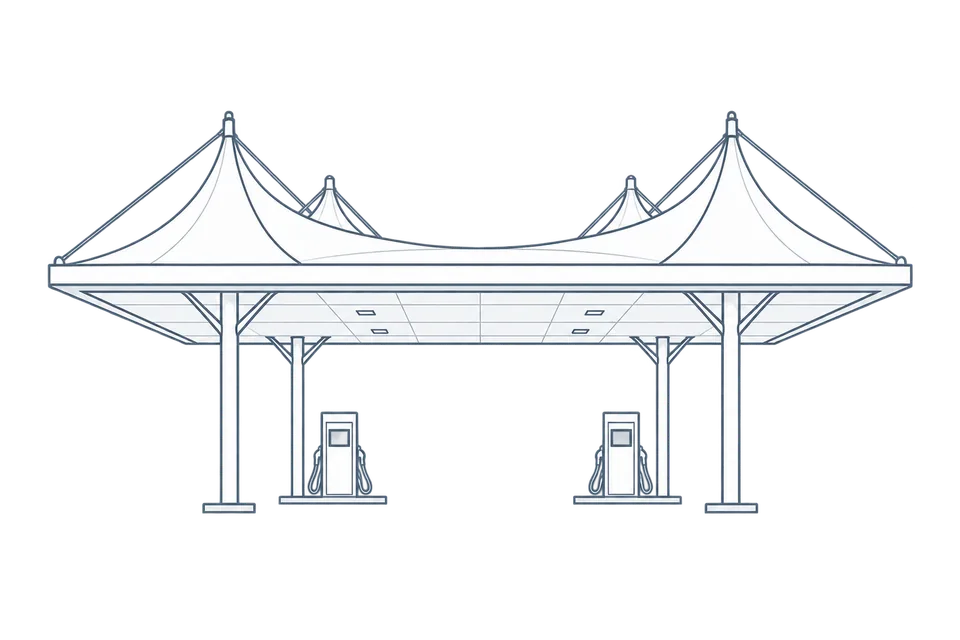 Fuel station canopiesStation shelters→
 Entrance canopiesWalkways and entrances→
When Does a Tensile Membrane Structure Order Need Trial Assembly? A Buyer's Checklist for Custom Fabrication
Trial assembly (pre-erection fit-up) is not a standard feature on every custom fabrication order for a tensile membrane structure — it is a negotiated item for specific interface conditions. In short: when connections between components depend on on-site alignment accuracy and there is no margin for adjustment on site, trial assembly at the fabrication stage should be discussed before the order is placed. As the buyer, your job is to write the inspection scope, inspection method and record format into the order item by item — not to leave it at a vague "factory inspection passed".
The sections below cover, in order: which interfaces call for trial assembly, how to write inspection items into the order, and what still needs re-checking after delivery.
1. Which interfaces should be raised for trial assembly at the drawing stage
Not every component in a membrane canopy project needs trial assembly. For a conventional single-span carport, columns and beams that are bolted on site with slotted or oversize adjustment holes can usually be covered by factory acceptance plus on-site re-checking. The following interface types are worth raising for trial assembly during drawing confirmation:
1. Non-standard nodes and connections with complex spatial angles. Membrane canopies and grandstand structures often have raking columns, curved members or non-orthogonal beam-to-column nodes. Even a small angular deviation can leave holes misaligned or membrane tensioning points out of position, and rework on site costs far more than one extra step in the workshop.
2. Multi-span or multi-unit splice positions. When several units are joined in a row, the connecting members between spans must satisfy alignment requirements at both ends at once. Errors accumulate across units, and checking single pieces will not reveal the problem.
3. Site-bolted interfaces where re-drilling is not allowed. If the contract states that no drilling, hole enlargement or hot cutting will be done on site, hole accuracy depends entirely on workshop precision. These interfaces are the classic case for trial assembly.
4. Interfaces between membrane tensioning points and the steel framework. Membrane panels are welded in the workshop to the cutting pattern. If the position of tensioning points, the direction of lug plates and their heights do not match the actual steelwork, the membrane surface will wrinkle or tension unevenly. For projects with non-standard membrane geometry or long spans, this item deserves separate confirmation.
Conversely, if the design is conventional, the members are simple and there is adjustment room on site, you can discuss with the supplier whether factory acceptance plus spot-checking of key dimensions can replace full-frame trial assembly, controlling cost and schedule.
2. How to write the inspection scope into the order and contract
Whether trial assembly happens, what is checked, who witnesses it and what records are left — all of this should be put in writing before the order is confirmed. At minimum, the order or technical agreement should state:
- Objects and scope of trial assembly: specify exactly "which components, which interfaces", e.g. "the column-to-beam node of unit X" or "all multi-span connecting members" — not just "main components".
- Itemised inspection list: list the dimensions to be verified — node centre distances, hole positions and hole spacings, member lengths, angles, lug plate orientation, heights and directions of membrane tensioning points — each item cross-referenced to a drawing number.
- Acceptance criteria and deviation handling: agree how conformity is judged, and whether deviations are corrected, supplied as replacement parts or re-fabricated, and how responsibility and cost are shared.
- Witnessing and records: whether the buyer attends in person or witnesses remotely by video; what records the trial assembly produces — inspection sheets, photographs, component numbering cross-references — and whether these accompany the shipment.
- Interface with transport and the site: how components are disassembled, packed and numbered after trial assembly, so installation can restore the verified assembled configuration on site.
One reminder: trial assembly is a negotiated process item. Whether it can be done, and how, depends on the fabricator's yard and the project conditions. Ask directly before ordering rather than assuming "every factory has it".
3. What trial assembly records do not replace
Passing trial assembly does not make on-site re-checking unnecessary. Transport, handling and storage introduce new variables, and trial assembly verifies fit-up under factory conditions — it does not cover the actual state of foundations and the site environment. After delivery, the following checks should not be skipped:
Condition of the components themselves. Verify numbering and quantity piece by piece against the packing list, and inspect coatings, welds and easily damaged areas for transport damage. Record any issues on the spot and agree handling with the supplier.
Interface dimensions. Spot-check hole spacings and diameters at key bolted interfaces and compare with the trial assembly records. If delivered dimensions do not match factory records, something went wrong in transport or storage — raise it immediately rather than forcing installation.
As-built measurement of foundations and embedded parts. However accurate the trial assembly, mispositioned anchor bolts will not connect. Measure the actual position and level of embedded bolts against column base plate holes before erection. If deviations exceed the adjustable range, correct the foundation first — do not force-correct the members.
Membrane panels and tensioning points. After unwrapping the membrane panels, verify numbering, orientation and dimensions, and confirm that membrane tensioning points correspond to the lug plates on the steelwork before starting tensioning.
4. Coordination items for site-bolted projects
For projects bolted on site, confirm the following with the fabricator and the installing contractor before work starts:
- Bolt specification, grade and quantity list, supplied with the goods, with spare quantities agreed.
- Erection sequence and temporary bracing: for multi-span or multi-unit projects, which unit goes up first and how it is temporarily stabilised, so the sequence problem is not discovered halfway through.
- Where the adjustment margin is: which holes are slotted, which locations allow fine adjustment, and over what range.
- Intermediate check before membrane installation: confirm overall steelwork dimensions and tensioning point positions after bolting is complete, before hanging the membrane, so steelwork problems are not discovered after the membrane is on.
- Boundaries on hot work and re-drilling: if the contract excludes hot work and re-drilling on site, confirm in advance that this condition is fully covered by trial assembly and factory acceptance.
Summary
Trial assembly answers "does it fit together in the workshop"; on-site re-checking answers "does it still fit together on site". Neither replaces the other. Three things to hold on to as a buyer: judge at the drawing stage which interfaces need trial assembly; write the inspection items into the contract line by line; and after delivery, insist on on-site re-checking beyond factory acceptance — especially foundation embedment and membrane tensioning points.
To discuss custom fabrication and supply scope for your project, prepare the intended use, dimensions or available drawings, and the services you need — design coordination, fabrication and component supply. You can first review our fabrication and supply scope (fabrication and supply solutions), then share your project location, intended use, dimensions and available drawings, and tell us which services you need so we can review the scope together.