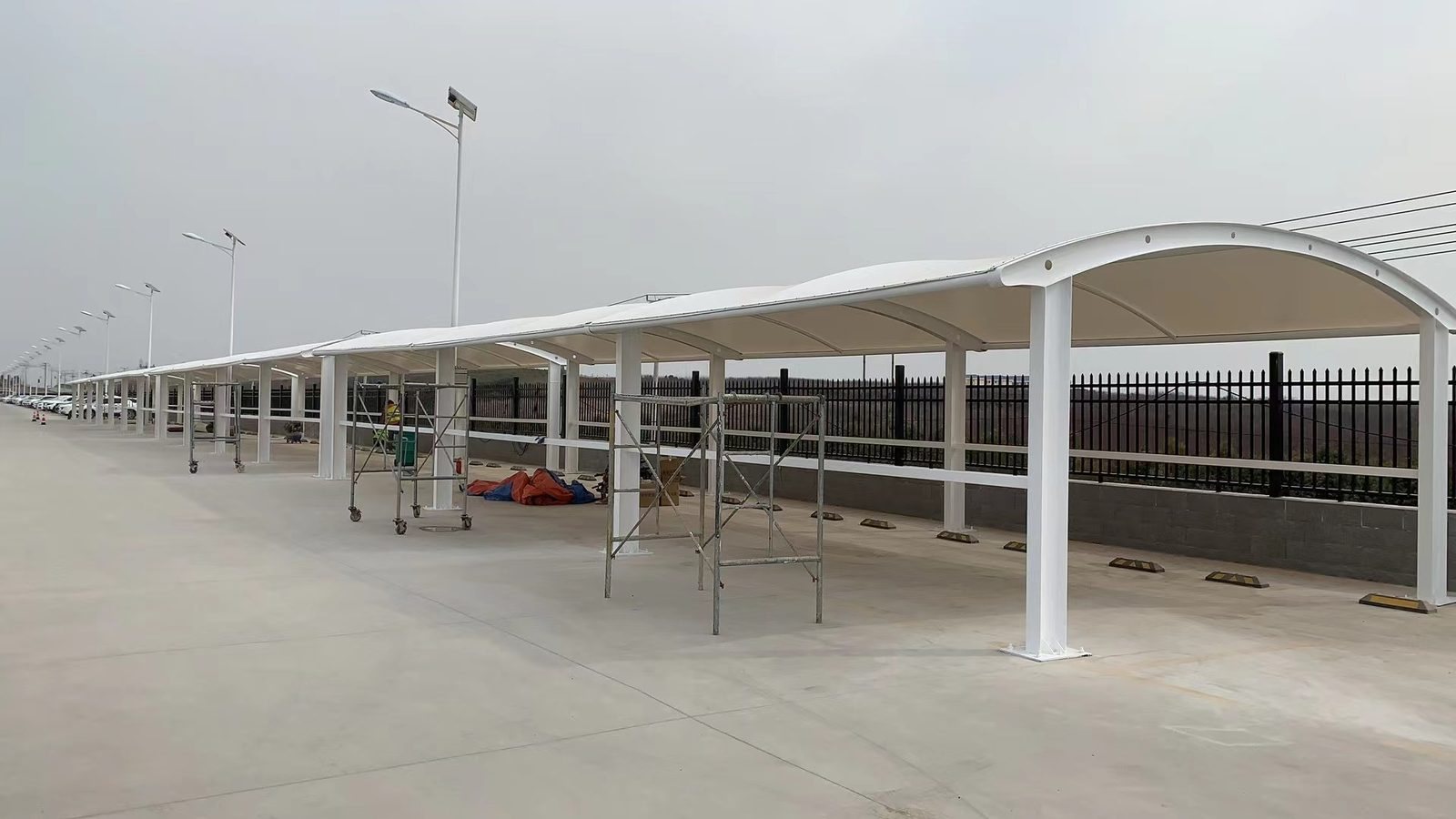
 Membrane carportsClassic membrane shelters→
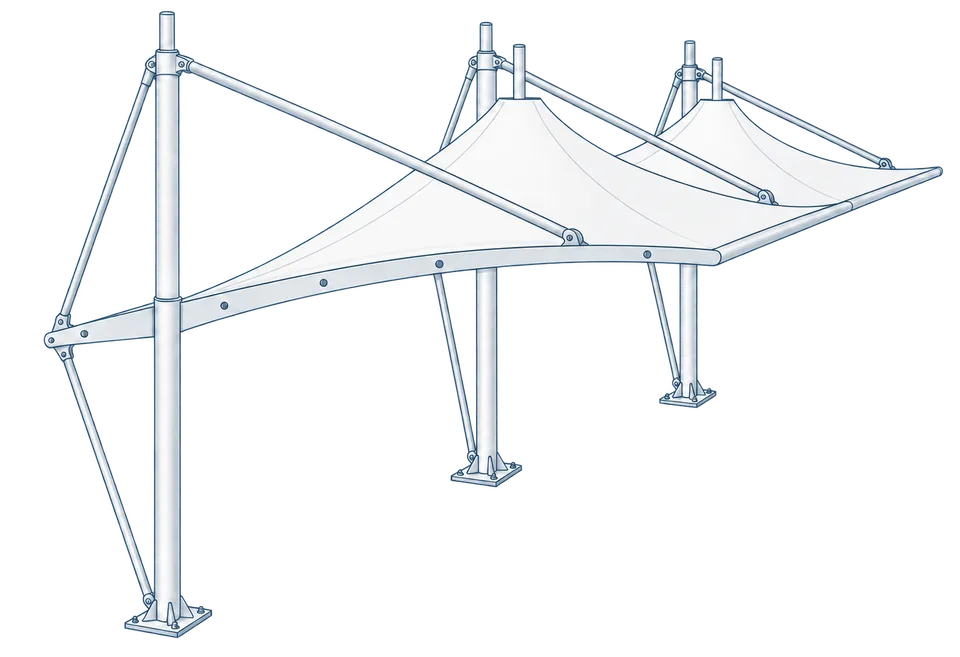
 Solar carportsParking meets green energy→
 Landscape canopiesParks and leisure spaces→
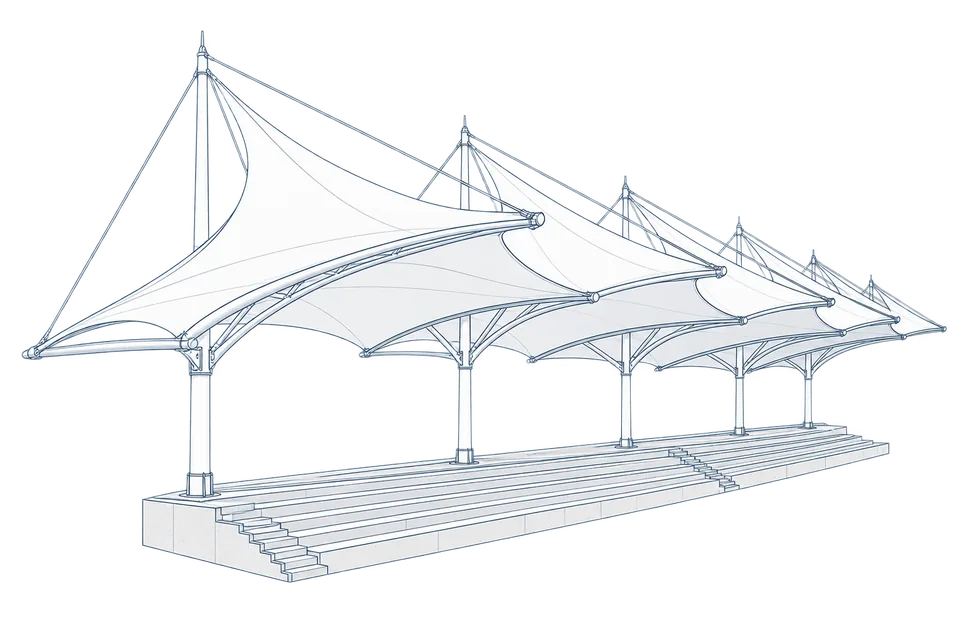 Grandstand canopiesSports venue shelters→
 Inflatable play cloudsFamily play areas→
 Wastewater coversEnvironmental infrastructure→
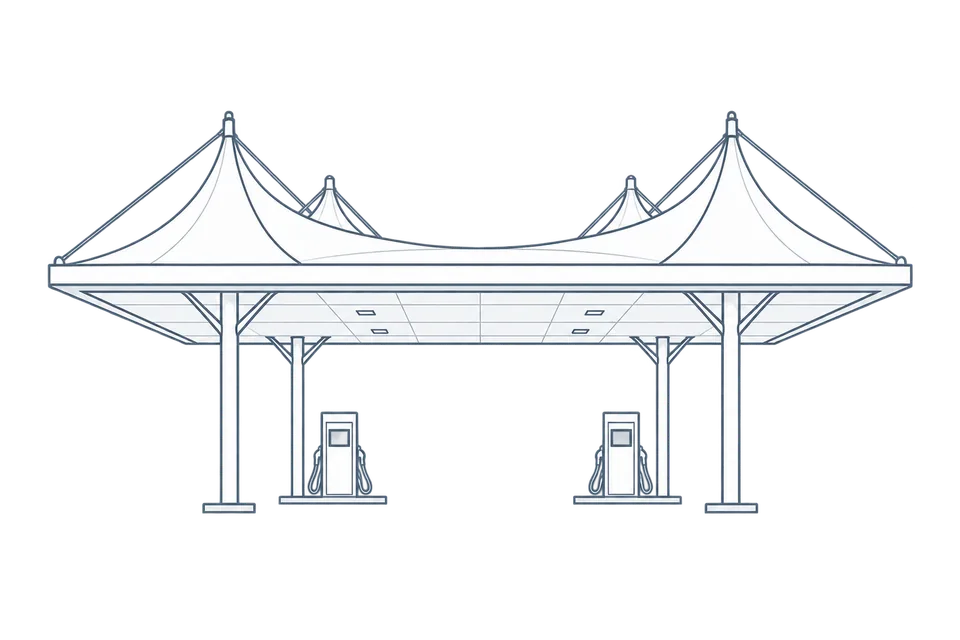 Fuel station canopiesStation shelters→
 Entrance canopiesWalkways and entrances→
What Fire-Safety Conditions Should Be Checked for a Membrane Carport or Grandstand Canopy?
A membrane carport or grandstand canopy cannot be assessed for fire safety from the membrane product name alone. The main conditions are: how the specified membrane behaves when exposed to fire, the actual use and layout of the site, and whether the supporting steel structure requires fire protection. These factors must be reviewed together against the local fire authority's requirements and the project design documents.
This article provides a review framework, not a fire-safety conclusion for a particular project. Final requirements should be confirmed by the buyer, the project engineer and the relevant local authority.
1. Confirm the membrane material and its fire-test evidence
PTFE membrane, PVC membrane and ETFE film have different combustion characteristics. Before issuing a request for quotation (RFQ), meaning a formal request for pricing and technical scope, confirm which material is being considered and request the applicable test documentation.
- PTFE membrane: This material normally uses a glass-fibre fabric substrate, which is non-combustible. The source article identifies PTFE membrane as an option often considered for locations with higher fire-performance requirements because it does not support combustion.
- PVC membrane: PVC membrane is described as flame-retardant and capable of self-extinguishing after the ignition source is removed. Under sustained high temperatures, however, it can soften and melt. It is widely used for conventional carports and grandstand canopies, but its performance depends on the specified flame-retardant formulation. If a project requires a B1-rated membrane solution, that requirement should be defined during design and checked against the applicable local rules. Buyers should not assume that a Chinese B1 designation is automatically equivalent to a classification used in another country.
- ETFE: ETFE is a film rather than a woven fabric. When exposed to fire, it melts and contracts and is described in the source as not producing molten droplets. It is commonly considered for applications such as cushions and transparent enclosures.
The material name is not sufficient evidence of compliance. Review the membrane test report, the tested specimen and the test conditions. The required fire-performance classification should be written into the technical specification, purchase contract and approved material documents.
2. Review the actual project conditions
The same membrane may lead to different conclusions when used in different locations. The project engineer should assess at least the following conditions.
Is the structure open or enclosed?
An open-sided outdoor carport allows smoke to disperse differently from an enclosed or partially enclosed grandstand canopy or covered walkway. The degree of enclosure can affect smoke accumulation and the applicable design approach.
What combustible items are below the membrane?
The use beneath the canopy is important. A standard vehicle parking area, an electric-vehicle charging area, stored materials and temporary facilities do not present the same conditions. The type and quantity of combustible materials should therefore be identified in the design information.
What are the membrane height and position?
A higher membrane surface may be less directly exposed to a fire below it, while a low membrane edge close to an ignition source or combustible item can present greater risk. The relevant height is not simply the maximum height shown on an elevation.
Tensile membrane structures often have curved, double-curved or irregular surfaces. The drawings should identify the actual height at low points, perimeter edges and areas close to vehicles, equipment or other combustible items. The highest point must not be used to represent the entire membrane canopy.
Position can be as important as height. Separation from combustible materials or open-flame sources should be determined by the project design and local requirements rather than estimated by the supplier or buyer. The source article also recommends avoiding membrane surfaces directly above or beside evacuation exits where their position could affect safe evacuation. This should be resolved during concept and design coordination, not left for adjustment during installation.
Fire design should assess the membrane in its complete condition. It should not rely on the membrane burning through to create an opening for smoke exhaust.
3. Include evacuation requirements in design coordination
Grandstands and enclosed canopy areas may accommodate groups of people. The project design should therefore consider whether occupants can leave within the required time and whether evacuation routes remain usable.
For international procurement, provide drawings showing exits, circulation routes, stairs, aisle widths and the position of the membrane and steelwork relative to those routes. Responsibility for evacuation design, fire engineering and approval under local building rules should be agreed between the buyer and the buyer's project engineer. A custom fabrication supplier should not be assumed to hold responsibility for local statutory approval unless this is expressly established in the contract.
4. Do not overlook fire protection for the steel structure
Fire safety is not only a membrane issue. Supporting steel loses strength as its temperature increases. Even if the membrane has flame-retardant properties, failure of the steel frame could cause the canopy to become unstable or collapse.
The supporting frame should therefore receive the fire protection required by the applicable project design and local rules. The method, required performance, surface preparation, coverage and inspection responsibilities should be defined by the project engineer.
When requesting custom fabrication, ask the supplier to state whether fire protection for the steelwork is included, excluded or to be carried out locally. This boundary should appear clearly in the supply scope, quotation and contract. Any coating system or other treatment should be coordinated with corrosion protection, finish requirements and site connection details.
5. Procurement checklist for the RFQ and drawing review
Provide and confirm the following information before approving the membrane and steelwork package:
- Project location, intended use and degree of enclosure.
- General arrangement drawings, dimensions and membrane geometry.
- Actual heights at peaks, valleys, low edges and locations near combustible items.
- Vehicle parking, electric-vehicle charging or other activities below the canopy.
- Evacuation exits, routes and any restricted zones around them.
- Required membrane type and fire-performance classification.
- Membrane test reports, specimen information and test conditions.
- Requirements for supporting-steel fire protection.
- Interfaces with foundations, drainage, lighting, charging equipment and other trades.
- Design responsibility, revision procedure and drawing approval authority.
- Fabrication, membrane production, accessories and other items included in the supply scope.
- Items excluded from supply, including any work to be completed by local contractors.
- Material documents, packing lists, component identification and handover information required by the local installer.
Project-specific terminology should be confirmed from approved drawings and material documents. Revisions affecting membrane material, geometry, use, evacuation arrangements or steel protection should be reviewed and approved before fabrication.
Final basis for the decision
The final fire-safety requirements should be based on three sources: local fire authority requirements, the approved project design documents and the applicable material test reports. Promotional descriptions are not a substitute for tested data or project-specific engineering.
Share your project location, intended use, dimensions and available drawings. Tell us which design coordination, fabrication and supply services you need so we can review the scope. Our design-build service scope is described on the design-build page, and you can contact us there with your project information.